Half past seven on a November morning, rain coming in sideways, and the outfit you planned already looks wrong. Most winter outfits for women are put together for cold, still days, not for damp wind. The fix is seldom a new wardrobe. It is the right order of layers, a coat that keeps the wet out and boots that grip.
What winter outfits for women have to deal with in Britain
Cold is the easy part. A British winter is mostly damp: grey light, a wind that makes mild air feel properly raw, and rain that arrives halfway through the commute. Add overheated trains and offices, and you can go from sweating to shivering inside a single trip. Three demands follow from that. The layer next to the skin has to stay comfortable when it is slightly wet. The outer layer has to stop wind and keep rain off. And you need something you can take off indoors without the outfit falling apart. A thick coat over one thin top fails the first test. A light jacket over a heavy jumper fails the second. Judge each piece by how it works with the other two, then test the whole outfit against a wet pavement and a brisk wind rather than a hallway mirror.
Base layers and knitwear that keep their warmth in the damp
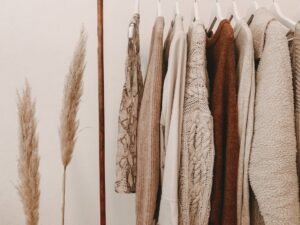
Start next to the skin, because that layer decides how warm the rest of the day feels. A fine merino or thermal top in a neutral shade earns its place: wool tends to stay comfortable when it is a little damp, while cotton turns heavy and cold on a long walk. Over it, choose knitwear by job. A fine-gauge merino or wool jumper slides under a coat without bulk. A chunky cable knit is better kept as the main warm layer for dry, cold days or a weekend indoors. Cashmere is soft and light, but it pills with friction and needs gentle washing, so it suits a desk day better than a rainy commute. Keep the colours to two or three tones, such as navy, oatmeal and grey, and the layers will look chosen rather than piled on. It also makes dressing in the dark of a winter morning quicker.
Trousers, skirts and tights on a wet day
Wet hems are the quiet misery of a British winter. Trousers in a wool blend or a tightly woven twill dry faster and hold their shape better than denim, which soaks up rain on a long walk and stays cold for hours. A straight or slim leg keeps clear of the pavement, while wide hems drag. Lined trousers are worth having for the worst of January. Skirts work well if the legs are properly covered. Opaque tights in a mid-weight or brushed finish are warmer than sheer ones, and a pair close to your skin tone can look softer than black. In the coldest weeks, thermal leggings under a midi skirt or a knitted dress add warmth without bulk. Whatever you wear, check where the hem lands. If it touches the ground, it will be wet and muddy before you reach the office.
Boots and shoes that grip wet pavements
Look at the sole before anything else. Rubber or a deep lugged tread grips wet paving far better than smooth leather, which skates on tiles and kerbs alike. Leather treated for water resistance keeps feet dry for longer, and it can be cleaned and re-proofed when the finish dulls. Suede looks lovely in a shop window, but it stains easily and soaks up rain, so save it for dry days or give it a protective spray first. Ankle boots suit most trousers and skirts. Taller boots work best over slim trousers or under a midi skirt, where the top of the boot meets the tights or the hem. For days on your feet, choose a block or low heel over a thin stiletto; it is steadier on slippery ground and still looks smart. Whatever the boot, a wool-blend sock adds warmth without making it too tight.
Outfit formulas for the days the forecast looks grim
Good winter outfits are repeatable. Once you have a warm base, a layer you can remove indoors, legs covered by wool or opaque tights and boots with a proper sole, everything else is a swap of colour or fabric. Each of the six formulas is built on that base. Treat them as templates rather than rules: a cardigan can stand in for a waistcoat, a knitted dress for a skirt and jumper. Cute and warm are not opposites. A good knit, a pleated skirt and polished boots look as put together as anything chosen for looks alone, and the last formula is the dressier version for an evening out. Pick the one closest to what you already own, then note the single piece that is missing. That gap is usually the coat, and the coat deserves more thought than anything else you wear.
- Fine merino top, chunky cardigan, wool-blend trousers, lugged-sole ankle boots
- Thermal top, fitted jumper, midi skirt, opaque tights, tall rubber-soled boots
- Shirt, knitted waistcoat, twill trousers, longline wool coat, re-proofed leather boots
- Roll-neck, pleated midi skirt, brushed tights, block-heel boots, waterproof shell coat
- Thermal leggings, loose knitted dress, fleece-lined parka, rubber boots
- Evening out: fine knit, satin midi skirt, opaque tights, block-heel boots, long coat
The coat to buy first, and what to look for
Spend the most on the coat, because it decides whether the rest of the outfit works. For rain and wind, look for a tightly woven or coated outer fabric and a hood or a collar that fastens close at the neck. Wool looks smart and insulates well, but it is not waterproof unless it has a treated finish, so it suits dry, cold days better than a downpour. A coat that ends below the knee keeps the wind off the backs of your legs. Scarves, hats and gloves are easy to add once the coat is right. Before buying, put on your thickest jumper, fasten the coat, raise both arms and sit down. If it pulls across the back, it will annoy you daily. If you buy only one thing for winter, make it the coat: a waterproof shell if you walk or wait for buses, treated wool if your days are mostly dry.